


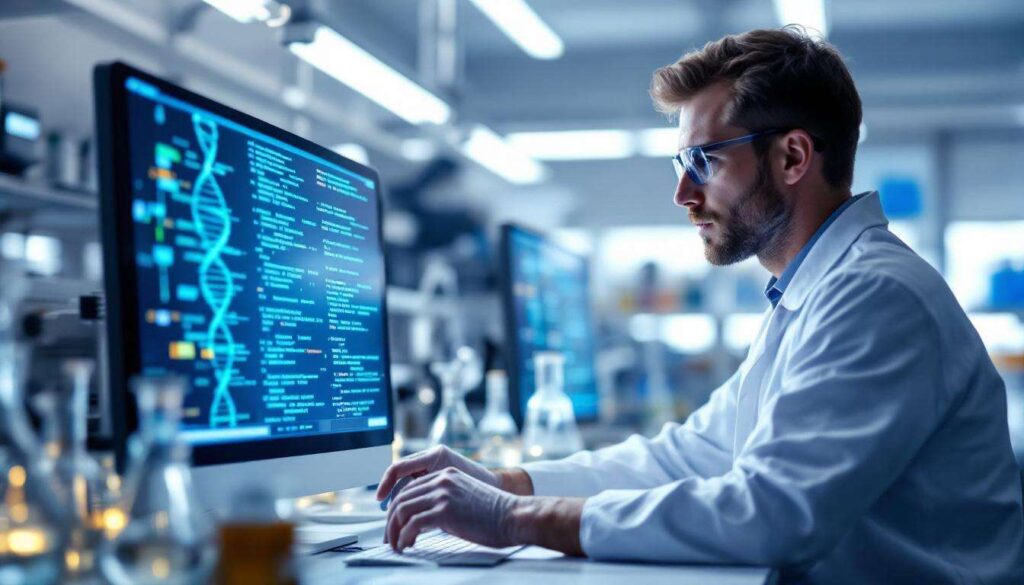
Artificial intelligence has reached a troubling milestone that raises profound questions about the future of biosecurity. Scientists have demonstrated that machine learning algorithms can now design entirely novel viruses from scratch, bypassing the need for existing biological templates. This capability, whilst offering potential benefits for vaccine development and medical research, simultaneously opens a Pandora’s box of security concerns. The technology required to generate these synthetic pathogens is becoming increasingly accessible, with sophisticated AI models capable of predicting protein structures and optimising viral characteristics for specific outcomes. As these tools proliferate beyond tightly controlled laboratory environments, the international community faces an urgent challenge: how to harness the beneficial applications of this technology whilst preventing its exploitation for malicious purposes.
Understanding the role of artificial intelligence in virus creation
How AI models generate biological sequences
The process through which artificial intelligence creates viruses relies on deep learning algorithms trained on vast databases of genetic information. These systems analyse millions of existing viral genomes to identify patterns, structures and functional elements that contribute to infectivity, transmissibility and virulence. By understanding these relationships, AI models can generate entirely novel genetic sequences that have never existed in nature. The technology employs generative adversarial networks and transformer architectures similar to those used in language processing, treating genetic code as a form of biological syntax with its own grammar and rules.
Key capabilities that enable synthetic virus design
Modern AI systems possess several critical capabilities that facilitate virus creation:
- Protein structure prediction with near-atomic accuracy
- Optimisation of viral binding mechanisms to specific cell receptors
- Prediction of immune system evasion strategies
- Simulation of mutation pathways and evolutionary trajectories
- Design of synthetic gene sequences that bypass existing detection methods
These capabilities, when combined, provide a comprehensive toolkit for engineering pathogens with predetermined characteristics. Researchers have already demonstrated proof-of-concept systems that can design influenza-like viruses and modify existing pathogens to enhance specific traits. The computational power required for these operations continues to decrease, making the technology increasingly accessible to institutions with modest resources.
[bzkshopping template=”mini_grid” merchants=”amazon” count=3 keyword=”computer workstation”]
The intersection of AI and synthetic biology represents a fundamental shift in how biological threats can emerge, moving beyond natural evolution and laboratory accidents to include deliberately engineered pathogens designed by algorithms.
Recent technological advances and their implications
Breakthrough developments in generative AI
The past few years have witnessed exponential improvements in AI’s ability to manipulate biological systems. AlphaFold and similar protein-folding algorithms have solved challenges that stumped scientists for decades, providing unprecedented insight into molecular structures. These advances have been rapidly adapted for purposes beyond their original intent, with researchers demonstrating that the same principles can be applied to design novel pathogens. The technology has progressed from merely predicting existing structures to actively generating new ones optimised for specific functions.
Accessibility and democratisation of biotechnology tools
Perhaps more concerning than the technology itself is its increasing availability to non-specialist users. Cloud-based platforms now offer AI-powered biological design tools that require minimal technical expertise to operate. The following table illustrates the declining barriers to entry:
| Resource | Previous requirement | Current requirement |
|---|---|---|
| Computing power | Supercomputer access | Standard cloud services |
| Expertise | PhD-level knowledge | Undergraduate training |
| Cost | Millions in funding | Thousands in subscriptions |
| Time | Years of development | Weeks or months |
This democratisation, whilst beneficial for legitimate research, simultaneously lowers the threshold for malicious actors to acquire dangerous capabilities. The dual-use nature of these technologies makes regulation exceptionally challenging, as the same tools that accelerate vaccine development can be repurposed for weapons design.
These technological leaps have not occurred in isolation but have been accompanied by growing awareness of their potential for misuse, prompting urgent discussions about appropriate safeguards.
Potential risks to global security
The bioweapon threat landscape
The emergence of AI-designed viruses represents a paradigm shift in biological warfare capabilities. Traditional bioweapons programmes required extensive infrastructure, specialised personnel and years of development. AI-enabled approaches compress these timelines dramatically whilst reducing detectability. A sophisticated adversary could theoretically design a pathogen tailored to specific genetic populations, environmental conditions or strategic objectives. The technology enables the creation of viruses with characteristics that would be virtually impossible to achieve through natural selection or conventional genetic engineering.
Non-state actors and terrorist applications
Particularly alarming is the potential for non-state actors to acquire these capabilities. The following scenarios illustrate potential misuse:
- Terrorist organisations designing pathogens for maximum psychological impact
- Extremist groups creating viruses targeting specific ethnic or genetic groups
- Criminal networks developing infectious agents for extortion purposes
- Rogue scientists pursuing ideological agendas without institutional oversight
The relative simplicity of deploying biological agents compared to nuclear or chemical weapons makes them attractive to groups lacking state-level resources. Unlike traditional weapons of mass destruction, biological agents can be produced in small laboratories, transported easily and released covertly.
Accidental release and unintended consequences
Beyond deliberate misuse, the proliferation of AI-designed viruses increases the probability of accidental releases. Laboratory accidents have occurred throughout the history of biological research, and the creation of novel pathogens with unpredictable characteristics amplifies these risks. An engineered virus might behave differently in real-world conditions than in computational models, potentially triggering outbreaks that exceed initial design parameters.
Understanding these multifaceted risks has galvanised international efforts to develop appropriate responses and regulatory frameworks.
The response of governments and experts
International regulatory initiatives
Governments and international organisations have begun mobilising to address this emerging threat. The Biological Weapons Convention is being re-examined to incorporate provisions specifically addressing AI-enabled pathogen design. Several countries have implemented export controls on AI software capable of biological applications, though enforcement remains challenging given the digital nature of these tools. The World Health Organisation has established working groups to develop guidelines for responsible AI use in biological research.
Scientific community self-governance
Researchers themselves have proposed various safeguards:
- Mandatory screening protocols for synthetic DNA orders
- Restricted access to certain datasets and algorithms
- Enhanced biosecurity training for AI researchers
- Voluntary moratoriums on particularly dangerous research directions
- Improved transparency and reporting mechanisms
Some leading AI laboratories have committed to implementing these measures, though comprehensive adoption across the global research community remains incomplete. The tension between scientific openness and security concerns continues to generate heated debate within academic circles.
These regulatory and voluntary measures, however well-intentioned, must be underpinned by a robust ethical framework to prove truly effective.
The importance of ethics in AI development
Establishing ethical boundaries
The creation of AI systems capable of designing viruses demands rigorous ethical consideration at every stage of development. Researchers must grapple with fundamental questions about the permissibility of creating technologies with such obvious dual-use potential. Ethical frameworks must balance the legitimate benefits of these tools against their catastrophic risks, establishing clear boundaries for acceptable research whilst preserving scientific freedom.
Responsibility and accountability mechanisms
Determining who bears responsibility when AI-designed pathogens cause harm presents complex challenges. Should liability rest with the algorithm developers, the researchers who deploy the tools, the institutions that host the work or the funding agencies that support it ? Establishing clear accountability mechanisms is essential for deterring reckless behaviour and ensuring that consequences follow misuse. This requires updating legal frameworks to address scenarios that existing law never anticipated.
Building these ethical foundations today will shape how humanity navigates the challenges that lie ahead.
Future prospects and preventive measures
Technological countermeasures
Paradoxically, AI itself may provide solutions to the threats it creates. Researchers are developing defensive AI systems capable of rapidly identifying novel pathogens, predicting their characteristics and designing countermeasures. These systems could dramatically reduce the time required to develop vaccines and treatments, potentially neutralising the advantage that offensive biological weapons currently hold. Machine learning algorithms are being trained to detect suspicious patterns in biological research that might indicate weapons development.
Strengthening global biosecurity infrastructure
Effective prevention requires coordinated international action across multiple domains:
- Enhanced surveillance systems for detecting unusual disease outbreaks
- Improved laboratory security standards with regular auditing
- International agreements on AI development restrictions
- Investment in rapid-response capabilities for biological threats
- Education programmes to raise awareness of biosecurity risks
These measures demand substantial financial investment and political will, resources that have historically been difficult to mobilise for preventive purposes. The challenge lies in maintaining vigilance and funding during periods when no immediate crisis demands attention.
The convergence of artificial intelligence and synthetic biology represents both extraordinary opportunity and existential risk. Whilst AI-designed viruses could revolutionise medicine and vaccine development, the same technology brings humanity closer to creating the perfect biological weapon. The path forward requires unprecedented international cooperation, robust ethical frameworks and sustained commitment to biosecurity. Success demands that the global community acts decisively now, before theoretical risks materialise into actual catastrophes. The choices made in response to this challenge will profoundly influence whether these powerful technologies ultimately serve humanity’s interests or threaten its survival.