



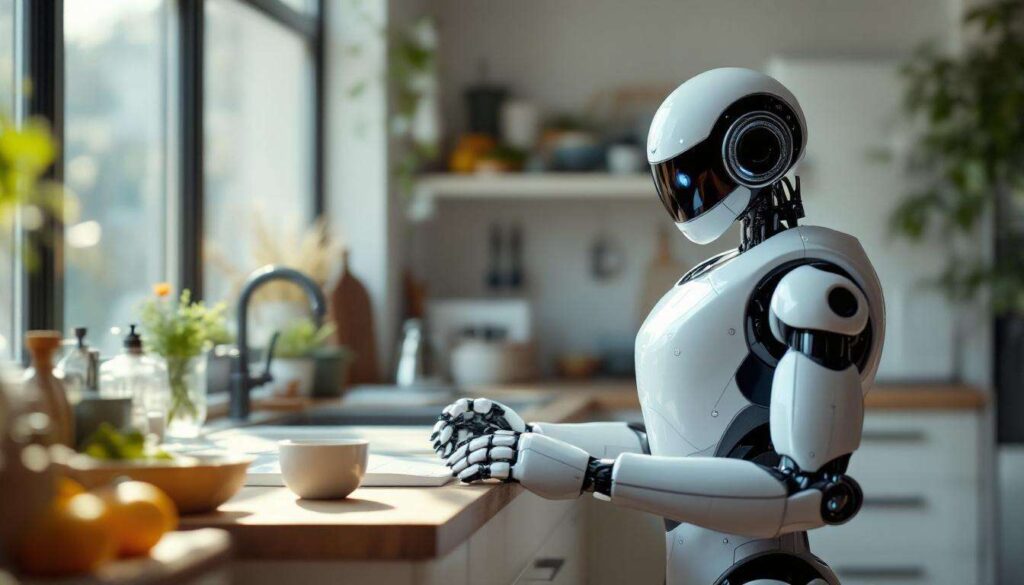
The prospect of humanoid robots assisting with household tasks has shifted from science fiction to tangible reality. Major technology companies and research institutions are investing heavily in developing machines capable of navigating the unpredictable nature of home environments. These mechanical helpers must master everything from folding laundry to tidying cluttered rooms, tasks that require sophisticated learning capabilities and adaptability. The journey towards creating truly useful domestic robots involves overcoming numerous technical hurdles, from understanding spatial dynamics to interpreting human intentions.
Humanoid robots in our daily lives
The emergence of domestic robotic assistants
Humanoid robots designed for household assistance are becoming increasingly sophisticated. Companies such as Tesla, Boston Dynamics, and numerous start-ups are developing machines with human-like forms that can manipulate objects and navigate residential spaces. These robots typically stand between 1.5 and 1.8 metres tall, equipped with articulated limbs and advanced sensor arrays that allow them to perceive their surroundings.
Current prototypes demonstrate capabilities that include:
- Picking up and sorting objects of various shapes and sizes
- Loading and unloading dishwashers
- Folding clothes and organising wardrobes
- Vacuuming and basic floor cleaning
- Carrying items between rooms
Practical applications in modern households
The integration of humanoid robots into homes addresses genuine needs for many demographics. Elderly individuals living independently benefit from assistance with physically demanding tasks, whilst busy families appreciate support with repetitive chores. Unlike specialised single-purpose devices, humanoid robots offer versatility, adapting to multiple household requirements without needing separate machines for each function.
These developments represent a significant step towards addressing labour shortages in caregiving and domestic services, whilst simultaneously offering solutions for those seeking greater independence in their living spaces. The technology continues to evolve rapidly, with each iteration bringing improved dexterity and understanding.
Learning of robots in the face of the unexpected
Adaptive learning systems
The hallmark of effective household robots lies in their ability to learn from experience rather than relying solely on pre-programmed instructions. Machine learning algorithms enable these robots to encounter new situations and develop appropriate responses. When a robot encounters a crumpled towel in an unusual location, it must determine whether to fold it, place it in the laundry basket, or hang it on a rack based on contextual clues.
Researchers employ several learning methodologies:
- Reinforcement learning: robots receive feedback on their actions and adjust behaviour accordingly
- Imitation learning: machines observe human demonstrations and replicate the techniques
- Transfer learning: knowledge gained from one task applies to similar but distinct activities
- Simulation training: robots practice in virtual environments before real-world deployment
Handling household unpredictability
Domestic environments present countless variables that challenge robotic systems. Toys scattered across floors, pets moving unexpectedly, or furniture rearranged between cleaning sessions all require real-time problem-solving. Advanced robots now incorporate probabilistic reasoning, allowing them to make educated guesses when complete information is unavailable.
For instance, when encountering a closed door, a robot must decide whether to wait, knock, or attempt to open it based on learned patterns about household routines and privacy norms. This level of contextual understanding marks a substantial advancement from earlier generations of domestic machines.
Artificial intelligence technologies at work
Computer vision and object recognition
The ability to identify and categorise objects forms the foundation of household robot functionality. Modern systems employ deep neural networks trained on millions of images to recognise items ranging from delicate glassware to bulky furniture. These vision systems must account for varying lighting conditions, partial occlusions, and objects in unexpected orientations.
| Technology | Function | Application |
|---|---|---|
| RGB-D cameras | Depth perception | Spatial mapping and obstacle avoidance |
| Semantic segmentation | Scene understanding | Distinguishing surfaces, objects, and spaces |
| Object tracking | Motion prediction | Following moving targets like pets or children |
Natural language processing for instructions
Effective human-robot communication requires sophisticated language understanding capabilities. Household members issue commands in natural, often imprecise language: “tidy up the living room” or “put away the shopping”. Robots must interpret these instructions, infer unstated requirements, and ask clarifying questions when ambiguity exists.
Recent advances in large language models have dramatically improved robots’ ability to understand context, idioms, and implied meanings. This linguistic competence enables more intuitive interactions, reducing the learning curve for users unfamiliar with technical systems.
Challenges of navigating in a domestic environment
Spatial awareness and mapping
Creating and maintaining accurate maps of constantly changing home environments presents significant technical challenges. Unlike warehouses or factories with predictable layouts, homes feature irregular floor plans, multiple levels, and frequent modifications. Robots must simultaneously localise themselves within a space whilst updating their understanding of that environment.
Key navigation obstacles include:
- Narrow doorways and corridors requiring precise manoeuvring
- Stairs and uneven surfaces demanding balance control
- Dynamic obstacles such as opened cabinet doors or moved chairs
- Slippery or soft surfaces like rugs and carpets
- Low-light conditions in certain rooms or times of day
Manipulation in cluttered spaces
Grasping and manipulating objects within crowded environments requires exceptional dexterity and planning. A robot retrieving a specific book from a packed shelf must avoid toppling neighbouring volumes whilst maintaining stable grip on the target item. This demands real-time force feedback, tactile sensing, and predictive modelling of object behaviour.
Researchers continue developing more sophisticated gripper designs and control algorithms that replicate human hand capabilities. Some systems now incorporate soft robotics principles, using compliant materials that adapt to object shapes and reduce the risk of damage.
Human-robot interaction: an essential collaboration
Building trust and acceptance
The success of household robots depends not merely on technical capability but on human acceptance and comfort. People must trust that robots will handle possessions carefully, respect privacy boundaries, and operate safely around children and pets. This trust develops through consistent, predictable behaviour and transparent communication of robot intentions.
Design considerations for fostering positive interactions include:
- Expressive features or displays that communicate robot status
- Gentle movements that appear non-threatening
- Appropriate response times that feel neither rushed nor sluggish
- Clear feedback mechanisms confirming understood instructions
Collaborative task execution
Rather than replacing human effort entirely, effective household robots complement human activities. A person might sort laundry by colour whilst the robot handles the physical folding, or a user could identify which items need refrigeration whilst the robot unpacks shopping bags. This collaborative approach leverages human judgement alongside robotic consistency.
Future developments aim to create more seamless partnerships where robots anticipate needs based on learned household patterns, offering assistance proactively rather than waiting for explicit commands. Such systems must balance helpfulness with respect for autonomy, avoiding intrusive behaviour.
Towards a future where humanoid robots simplify daily life
Ongoing development priorities
The path to widespread adoption of household humanoid robots requires addressing several remaining challenges. Cost reduction remains paramount, as current prototypes remain prohibitively expensive for average consumers. Manufacturing scalability, component standardisation, and competitive market dynamics will gradually make these technologies more accessible.
Energy efficiency also demands attention, with current systems requiring frequent recharging that limits operational periods. Advances in battery technology and power management will extend robot autonomy, enabling them to complete more tasks between charging cycles.
Ethical and societal considerations
As robots become more integrated into domestic life, society must address important questions about privacy, data security, and employment impacts. Household robots equipped with cameras and microphones collect sensitive information about daily routines and personal spaces. Robust safeguards must protect this data from unauthorised access or misuse.
Additionally, the automation of household tasks may affect employment in cleaning and caregiving sectors, necessitating thoughtful policies that support workforce transitions whilst embracing technological benefits. The goal remains enhancing human quality of life rather than creating new problems through technological advancement.
Humanoid robots capable of managing household chaos represent a convergence of multiple technological disciplines, from artificial intelligence and computer vision to mechanical engineering and human-computer interaction. These machines learn through experience, adapting to the unpredictable nature of domestic environments whilst developing capabilities that complement human activities. Significant challenges remain in navigation, manipulation, and human acceptance, yet rapid progress continues across research institutions and commercial ventures. The collaborative relationship between humans and robots, built on trust and clear communication, will define successful integration into daily life. As costs decrease and capabilities expand, these mechanical helpers promise to transform how people manage their homes, offering support to those who need assistance whilst freeing others to focus on activities they find more meaningful than routine chores.