


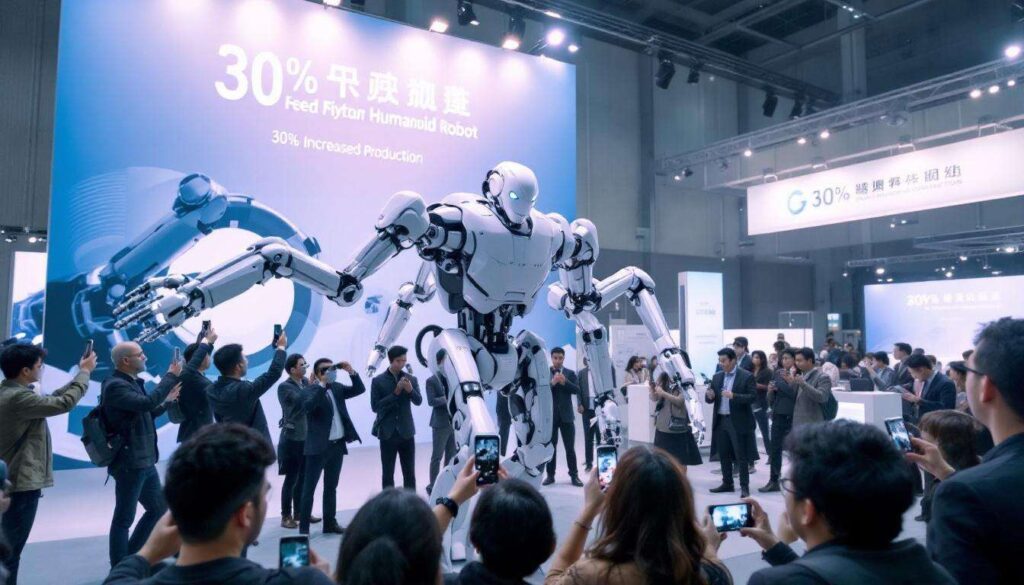
Chinese robotics manufacturer has unveiled what it claims to be the world’s first commercially viable six-armed humanoid robot, marking a significant departure from traditional dual-armed designs. The machine, developed by a consortium of engineering firms based in Shenzhen, represents a bold reimagining of industrial automation. With its manufacturer promising a 30% increase in productivity compared to conventional robotic systems, the innovation has captured the attention of factory owners and industry analysts worldwide. The additional limbs enable simultaneous multi-tasking capabilities that could transform production lines across various sectors.
Introduction of the six-armed robot in China
Unveiling at the Shenzhen Robotics Expo
The six-armed humanoid robot made its public debut at a major technology exhibition in Shenzhen, where it demonstrated its capabilities before an audience of international investors and manufacturing representatives. The prototype, designated as the HX-6A model, stands approximately 1.8 metres tall and weighs 120 kilograms. Unlike previous experimental multi-armed robots confined to research laboratories, this model has been engineered specifically for commercial deployment in factory environments. Engineers showcased the robot performing complex assembly tasks, handling delicate components with precision whilst simultaneously operating quality control equipment with its additional appendages.
Development background and research timeline
The development programme spanned four years and involved collaboration between three Chinese robotics firms and two university research departments. Funding came from both private investment and government technology grants aimed at advancing China’s position in the global robotics market. The project team faced considerable challenges in creating a control system capable of coordinating six independent arms without overwhelming the central processing unit. Breakthroughs in neural network algorithms and improved servo motor technology eventually enabled the seamless integration required for practical applications.
Understanding the technical specifications helps contextualise the economic advantages this technology might deliver.
Technical characteristics of the humanoid robot
Arm configuration and movement capabilities
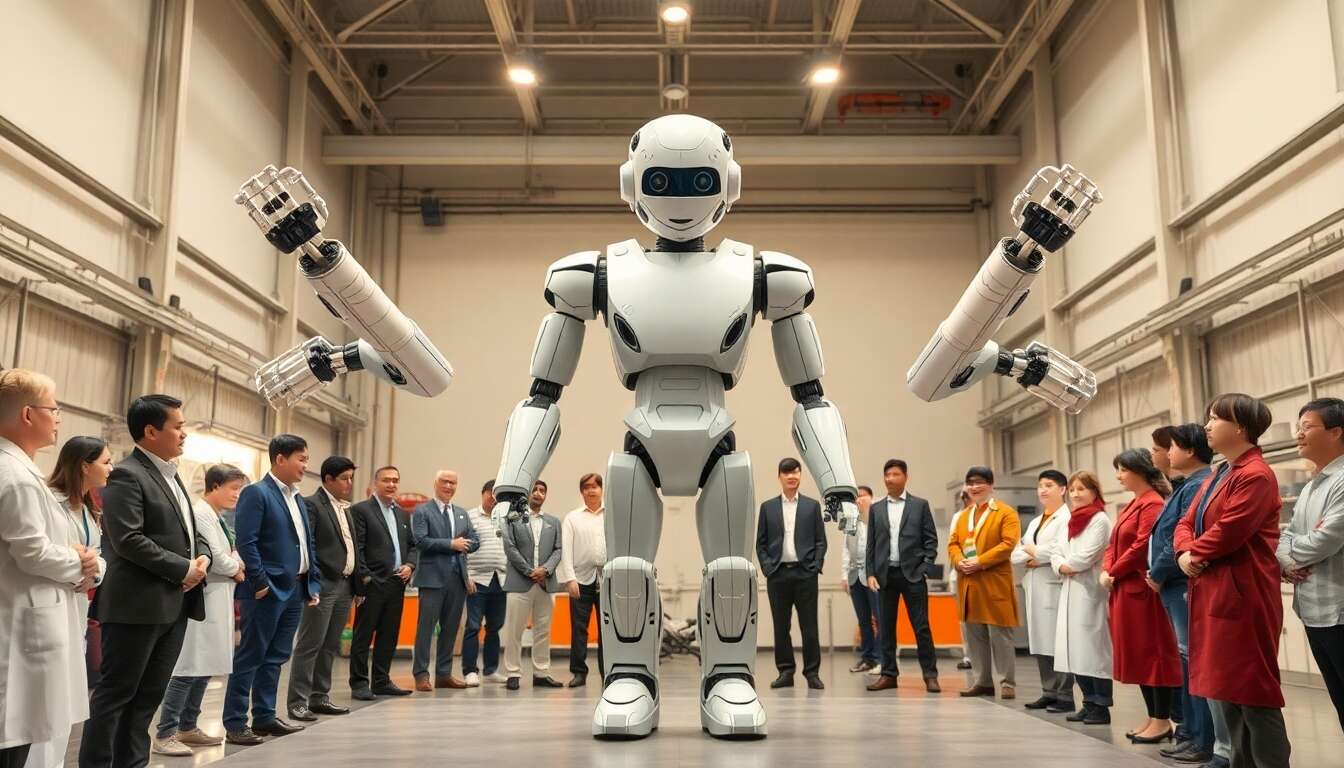
Each of the six arms features seven degrees of freedom, allowing for exceptional manoeuvrability in confined spaces. The upper four arms are positioned in pairs on either side of the torso, whilst two lower arms extend from the waist region. This configuration enables the robot to perform tasks at multiple heights simultaneously. The arms can lift up to 5 kilograms each, with a combined payload capacity of 30 kilograms when working in coordination.
| Specification | Value |
|---|---|
| Height | 1.8 metres |
| Weight | 120 kilograms |
| Arms | 6 independent units |
| Degrees of freedom per arm | 7 |
| Individual arm payload | 5 kilograms |
| Combined payload capacity | 30 kilograms |
| Operating time per charge | 8 hours |
Control systems and artificial intelligence integration
The robot employs a distributed processing architecture where each arm contains its own dedicated microcontroller, coordinated by a central AI system. Machine vision cameras mounted in the head unit provide real-time environmental awareness, enabling the robot to adapt to changing conditions on the production floor. The system can learn new tasks through demonstration, with operators guiding the arms through desired movements that are then stored and refined through repetition. This adaptive learning capability reduces programming time significantly compared to traditional industrial robots that require extensive coding for each new task.
[bzkshopping template=”mini_grid” merchants=”amazon” count=3 keyword=”industrial robot”]
These technical capabilities translate into tangible advantages for businesses considering adoption.
Expected economic benefits
Productivity improvements and efficiency gains
The manufacturer’s claim of a 30% productivity increase stems from the robot’s ability to perform multiple operations concurrently. In traditional assembly scenarios, a dual-armed robot might need to complete tasks sequentially, whereas the six-armed variant can simultaneously:
- Hold components in position with two arms
- Apply fasteners or adhesives with another pair
- Conduct quality inspections with the remaining two arms
- Reposition materials without interrupting the primary assembly process
This parallel processing approach reduces cycle times substantially, particularly in complex assembly operations where multiple steps would otherwise require separate workstations or additional robots.
Cost analysis and return on investment
Initial pricing estimates place the HX-6A model at approximately £180,000, which represents a premium of roughly 40% over comparable dual-armed humanoid robots. However, manufacturers argue that the productivity gains justify the higher capital expenditure. Based on typical manufacturing scenarios, companies could potentially achieve return on investment within 18 to 24 months through reduced labour costs and increased output. The robot’s energy consumption remains comparable to running three conventional industrial robots, making operational costs relatively modest. Maintenance requirements are projected to be similar to existing robotic systems, with scheduled servicing every 2,000 operating hours.
The economic case becomes clearer when examining specific sectors where this technology could be deployed.
Potential industrial applications
Electronics assembly and manufacturing
The electronics sector represents the most immediate market opportunity for six-armed humanoid robots. Circuit board assembly requires precise manipulation of numerous small components, with quality control checks at multiple stages. The additional arms enable the robot to hold a circuit board steady, place components, apply solder, and simultaneously inspect adjacent sections. Smartphone manufacturing facilities, in particular, could benefit from the ability to handle delicate screens whilst securing internal components and managing cable assemblies in a single operation.
Automotive component production
Automotive suppliers are exploring applications in dashboard assembly, wiring harness installation, and interior trim fitting. These tasks traditionally require human workers due to the complexity of simultaneously managing multiple parts whilst ensuring correct alignment. The six-armed configuration allows the robot to replicate this multi-handed approach, holding trim pieces in position whilst securing clips and routing cables. The technology shows particular promise in customisation scenarios where production runs are too small to justify dedicated single-purpose machinery.
Pharmaceutical packaging and logistics
Pharmaceutical companies face stringent requirements for sterile handling and precise packaging. Six-armed robots could revolutionise blister pack assembly by simultaneously loading medication, sealing compartments, printing batch information, and conducting quality verification. The ability to work in cleanroom environments whilst maintaining high throughput makes this technology attractive for an industry where contamination risks and regulatory compliance are paramount concerns.
Industry observers have responded to the announcement with a mixture of enthusiasm and caution.
Market reactions and perspectives
Industry expert opinions
Robotics analysts have expressed measured optimism about the commercial viability of multi-armed humanoid systems. Whilst acknowledging the technical achievement, some experts question whether the added complexity justifies the productivity gains in all scenarios. Concerns centre on programming complexity, maintenance requirements for multiple arm assemblies, and whether existing factory layouts can accommodate the robot’s unique form factor. Supporters counter that the flexibility offered by six independent manipulators provides options that fixed automation simply cannot match, particularly in mixed-model production environments where product variety is high.
Competitor responses and market positioning
Major robotics manufacturers in Japan, Germany, and the United States have taken note of the development. Several companies have indicated they are evaluating similar multi-armed concepts, though none have announced immediate plans to bring competing products to market. The announcement has intensified discussions about the optimal configuration for humanoid industrial robots, with some manufacturers arguing that improved AI and faster dual-armed systems might achieve similar results without the mechanical complexity. This debate reflects broader questions about whether humanoid robots should mimic human form or prioritise functional efficiency regardless of anthropomorphic constraints.
Looking beyond immediate market dynamics reveals broader implications for industrial automation.
The future of humanoid robotics in the industrial sector
Evolution of robotic workforce integration
The six-armed robot exemplifies a shift towards more versatile automation solutions that can adapt to varied tasks rather than excelling at a single repetitive operation. This flexibility aligns with manufacturing trends towards smaller batch sizes and greater product customisation. As factories move away from mass production of identical items, robots that can quickly switch between different assembly sequences become increasingly valuable. The humanoid form factor, whether with two arms or six, offers advantages in facilities designed around human workers, requiring minimal infrastructure modifications for robot deployment.
Challenges and development priorities
Several technical hurdles remain before six-armed robots become commonplace on factory floors. Power consumption and heat dissipation from multiple servo motors require improved battery technology or more efficient actuators. The control algorithms, whilst impressive, still struggle with unexpected situations that human workers handle intuitively. Safety certification for robots with multiple moving arms presents regulatory challenges, as existing standards were developed for simpler machines. Addressing these issues will require continued investment in research and collaboration between manufacturers, end users, and safety authorities.
Long-term implications for manufacturing employment
The introduction of more capable robots inevitably raises questions about workforce displacement. However, industry observers note that labour shortages in manufacturing sectors across developed economies create opportunities for automation to fill gaps rather than replace existing workers. The technology may enable companies to reshore production that had moved to lower-cost regions, potentially creating new jobs in robot maintenance, programming, and oversight. The transition will require workforce retraining initiatives and thoughtful implementation strategies that consider both economic efficiency and social impact.
The unveiling of the world’s first commercial six-armed humanoid robot marks a notable development in industrial automation technology. With its promise of 30% productivity improvements through simultaneous multi-tasking capabilities, the HX-6A model challenges conventional approaches to robotic design. Technical specifications demonstrate sophisticated engineering, whilst projected economic benefits suggest viable applications across electronics, automotive, and pharmaceutical sectors. Market reactions reflect both enthusiasm for innovation and pragmatic concerns about implementation challenges. As manufacturers evaluate this technology alongside evolving production requirements, the broader trajectory points towards increasingly adaptable robotic systems that complement human capabilities rather than simply replicating them. Whether six arms become standard or represent a specialised solution for specific applications will depend on real-world performance data and continued technological refinement.