


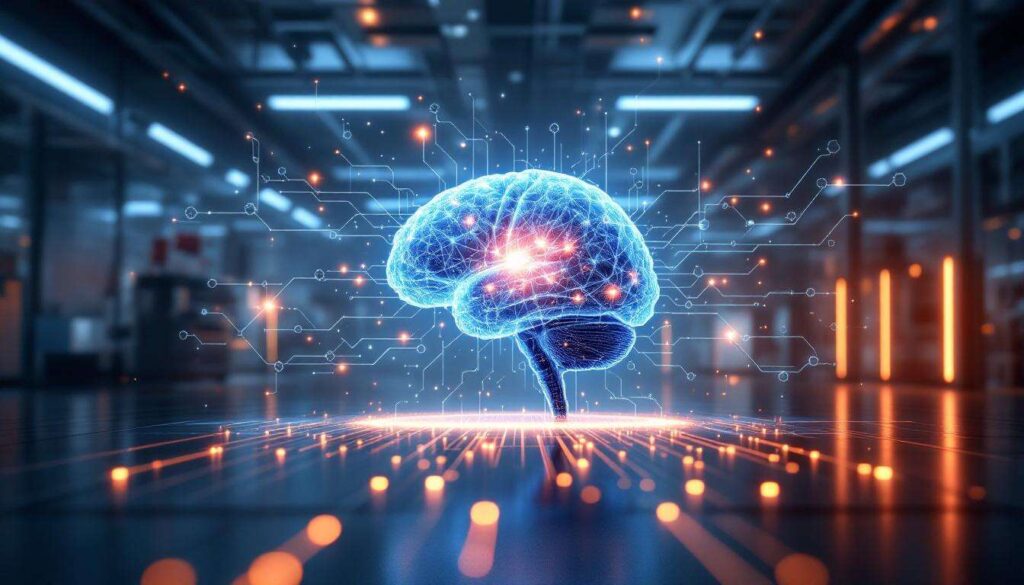
Scientists have unveiled a groundbreaking material capable of performing computations without relying on conventional transistors. This intelligent substance mimics the way neurons process information in biological brains, marking a significant departure from silicon-based electronics that have dominated computing for decades. The development represents a fundamental shift in how machines might think, learn and adapt, potentially revolutionising everything from artificial intelligence to energy-efficient computing systems.
Introduction to a new revolutionary material
The birth of brain-inspired computing materials
Researchers have engineered a neuromorphic material that processes information through physical changes in its structure rather than through electronic switches. Unlike traditional computer chips that rely on billions of transistors to perform calculations, this innovative substance alters its internal properties in response to electrical stimuli, creating a form of memory and processing capability embedded within the material itself.
The material consists of specially designed compounds that exhibit remarkable plasticity, allowing them to strengthen or weaken connections based on the frequency and intensity of signals passing through them. This behaviour closely resembles synaptic plasticity in human brains, where neural connections become more efficient with repeated use.
Key characteristics of the intelligent material
- Self-organising computational pathways that form without external programming
- Energy consumption dramatically lower than conventional processors
- Ability to process multiple inputs simultaneously in parallel fashion
- Built-in memory storage within the computing substrate itself
- Adaptive responses that improve with continued operation
This discovery builds upon decades of research into materials science and neuroscience, finally bridging the gap between biological intelligence and artificial systems. The implications extend far beyond incremental improvements in existing technology.
Functioning inspired by the human brain
Mimicking neural networks at the physical level
The human brain contains approximately 86 billion neurons connected by trillions of synapses, creating an incredibly efficient computing architecture that consumes merely 20 watts of power. The new material replicates this efficiency by allowing information to flow through pathways that physically change based on usage patterns, effectively learning from experience without software algorithms.
When electrical signals pass through the material, certain regions become more conductive whilst others become more resistive, creating a physical memory of previous computations. This process happens at the atomic or molecular level, enabling extraordinarily dense information storage and processing capabilities within a tiny volume.
Advantages of brain-like computation
| Feature | Traditional computing | Brain-inspired material |
|---|---|---|
| Processing style | Sequential operations | Parallel distributed processing |
| Memory location | Separate from processor | Integrated within computing substrate |
| Learning capability | Requires programming | Adapts through physical changes |
| Energy efficiency | High power consumption | Minimal energy requirements |
The material’s ability to process information holistically rather than through discrete logical operations opens entirely new possibilities for solving complex problems that have challenged traditional computers, particularly in pattern recognition and predictive modelling.
Potential applications in modern technology
Artificial intelligence and machine learning
The neuromorphic material could dramatically accelerate artificial intelligence development by providing hardware naturally suited to neural network architectures. Current AI systems run on conventional processors that must simulate brain-like behaviour through software, creating significant inefficiencies. Direct implementation in brain-inspired materials would eliminate this translation layer, enabling faster training and more sophisticated models.
Robotics and autonomous systems
Robots equipped with this intelligent material could process sensory information and make decisions with unprecedented speed whilst consuming minimal power. This advancement would prove particularly valuable for autonomous vehicles, drones and mobile robots where energy efficiency directly impacts operational range and capability.
- Real-time environmental analysis without cloud connectivity
- Adaptive behaviour learning from operational experience
- Enhanced safety through faster hazard recognition
- Extended battery life enabling longer missions
Medical and healthcare technologies
Implantable medical devices built with this material could monitor patient conditions, analyse complex biological signals and respond appropriately whilst operating for years on tiny batteries. The technology might enable intelligent prosthetics that adapt to user movements naturally or diagnostic tools that identify disease patterns with superhuman accuracy.
These diverse applications demonstrate how fundamentally this material could reshape technological landscapes across multiple sectors, setting the stage for understanding its advantages over existing solutions.
Comparison with traditional transistors
Limitations of silicon-based computing
Transistors have served as the foundation of computing since their invention, but they face fundamental physical limits. As manufacturers shrink transistors to nanometre scales, quantum effects begin interfering with reliable operation. Additionally, the separation between processing units and memory creates bottlenecks that waste energy shuttling data back and forth.
Modern processors contain billions of transistors switching on and off millions of times per second, generating substantial heat that requires elaborate cooling systems. This energy overhead limits both performance and portability, particularly problematic for mobile devices and data centres consuming vast amounts of electricity.
Advantages of the neuromorphic approach
| Aspect | Transistor-based systems | Intelligent material systems |
|---|---|---|
| Power efficiency | Watts to kilowatts | Milliwatts to watts |
| Processing speed | Gigahertz clock cycles | Instantaneous parallel operations |
| Scalability | Limited by heat dissipation | Minimal thermal constraints |
| Manufacturing complexity | Extremely precise lithography | Potentially simpler material deposition |
The intelligent material bypasses many constraints inherent to transistor technology by fundamentally rethinking how computation occurs, offering a pathway beyond the limitations threatening to halt progress in conventional electronics.
Implications for the future of computing
Transforming computational paradigms
Widespread adoption of brain-inspired materials would necessitate completely new approaches to programming and system design. Software developers would need to think in terms of training rather than coding, guiding materials to develop appropriate responses rather than specifying exact sequences of operations. This shift mirrors the difference between teaching a child through examples versus programming a robot with explicit instructions.
The technology could enable computers that genuinely understand context, learn continuously from interaction and solve problems through intuition rather than brute-force calculation. Such systems might finally bridge the gap between narrow AI that excels at specific tasks and general intelligence capable of flexible reasoning across domains.
Economic and industrial impacts
- Reduced energy costs for data centres and computing infrastructure
- New manufacturing industries centred on neuromorphic materials
- Obsolescence of some traditional semiconductor facilities
- Emergence of novel applications previously impractical
- Competitive advantages for early adopters in various sectors
These profound changes will reshape not only technology itself but entire economic structures built around conventional computing, creating both disruption and opportunity as industries adapt.
Challenges and opportunities for researchers
Technical obstacles to overcome
Despite its promise, the intelligent material faces significant hurdles before commercial viability. Researchers must develop reliable methods for manufacturing the substance consistently at scale, ensuring that each batch exhibits identical properties. Current production techniques remain largely experimental, suitable for laboratory samples but not mass production.
Integration with existing electronic systems presents another challenge, as the material requires specialised interfaces to communicate with conventional components. Scientists must also establish standards for programming and controlling these materials, developing tools and methodologies accessible to engineers beyond specialist research teams.
Research priorities moving forward
- Improving material stability and longevity under operational conditions
- Developing scalable manufacturing processes compatible with industrial production
- Creating design tools and frameworks for neuromorphic system development
- Establishing performance benchmarks and testing methodologies
- Exploring hybrid architectures combining traditional and brain-inspired elements
Collaborative opportunities
Progress will require interdisciplinary collaboration bringing together materials scientists, neuroscientists, computer engineers and mathematicians. Universities, technology companies and government research institutions worldwide are beginning to invest in neuromorphic computing programmes, recognising the transformative potential of this approach.
The journey from laboratory curiosity to commercial product typically spans decades, but the pace of advancement in neuromorphic materials suggests practical applications may arrive sooner than anticipated. Each breakthrough in understanding and controlling these intelligent substances brings closer the day when brain-inspired computing becomes mainstream.
The development of materials capable of computing without transistors represents a pivotal moment in technological evolution. By mimicking the efficiency and adaptability of biological brains, these intelligent substances promise to overcome limitations inherent in silicon-based electronics whilst enabling entirely new categories of applications. Though significant challenges remain in manufacturing, integration and standardisation, the potential benefits justify sustained research investment. As scientists refine these materials and engineers develop practical implementations, computing may finally transcend the transistor paradigm that has defined it for generations, ushering in an era of truly intelligent machines that learn, adapt and think in fundamentally new ways.