


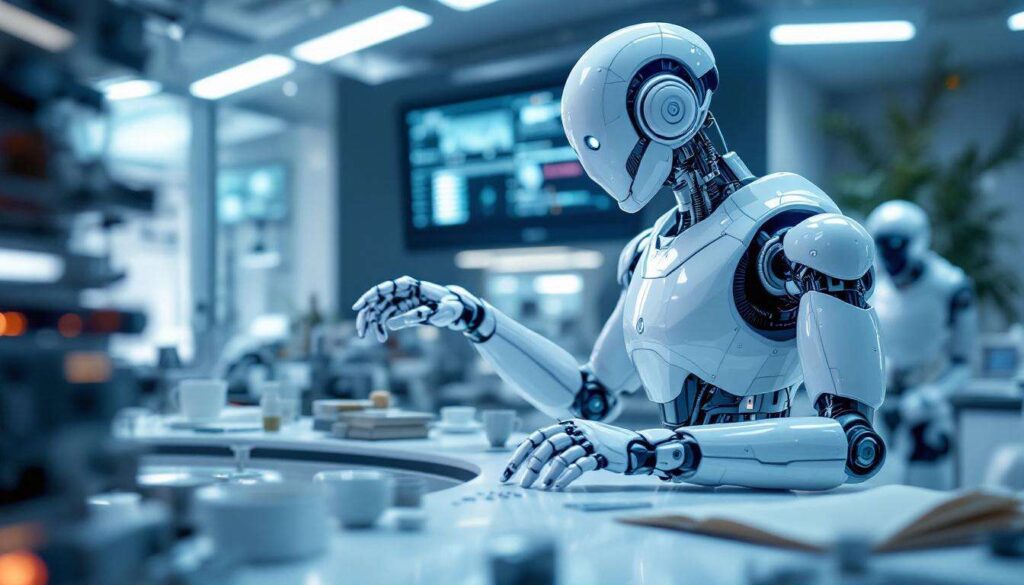
Robotics has entered a transformative phase where machines are no longer confined to repetitive tasks in controlled environments. The Apollo humanoid robot, developed in collaboration with Google DeepMind, represents a significant leap forward in artificial intelligence and robotic dexterity. This advanced system demonstrates remarkable capabilities in identifying and manipulating objects it has never encountered before, pushing the boundaries of what autonomous machines can achieve. By combining sophisticated hardware with cutting-edge machine learning algorithms, Apollo showcases how robots can adapt to unpredictable scenarios, a crucial requirement for real-world applications beyond factory floors.
Introducing the Apollo humanoid robot
Physical design and specifications
Apollo stands as a full-scale humanoid robot designed to operate in environments built for humans. The robot features a bipedal structure with articulated arms and hands capable of fine motor control. Its physical dimensions mirror human proportions, allowing it to navigate standard doorways, staircases, and workspaces without requiring environmental modifications. The design philosophy prioritises versatility over specialisation, enabling Apollo to perform diverse tasks across multiple sectors.
Key specifications include:
- Height of approximately 1.7 metres
- Weight of around 70 kilograms
- Multi-fingered hands with tactile sensors
- Omnidirectional vision systems with depth perception
- Battery life supporting several hours of continuous operation
Core capabilities and design objectives
The primary objective behind Apollo’s development centres on creating a general-purpose robotic assistant capable of functioning in unpredictable settings. Unlike industrial robots programmed for specific tasks, Apollo must interpret visual information, make decisions, and execute actions without explicit programming for every scenario. This requires advanced perception systems, real-time decision-making capabilities, and the physical dexterity to handle objects of varying shapes, sizes, and materials. The integration of these systems represents years of research in robotics, computer vision, and artificial intelligence.
These foundational capabilities set the stage for understanding the sophisticated technology that powers Apollo’s remarkable adaptability.
Innovative technology implemented by Google DeepMind
Machine learning architecture
Google DeepMind’s contribution to Apollo centres on a novel neural network architecture that enables the robot to generalise from limited training data. Rather than requiring thousands of examples of each object type, the system employs few-shot learning techniques that allow Apollo to recognise and manipulate new objects after minimal exposure. This approach draws on DeepMind’s expertise in reinforcement learning, where the robot learns through trial and error in simulated environments before applying that knowledge to physical tasks.
The architecture comprises several interconnected components:
- Visual processing networks that identify object features and boundaries
- Grasp prediction algorithms that determine optimal hand positions
- Physics simulation modules that anticipate object behaviour
- Motor control systems that translate decisions into precise movements
Transfer learning and simulation training
A critical innovation involves extensive simulation-based training where Apollo encounters millions of virtual objects before interacting with physical items. This transfer learning approach allows the system to develop intuitions about object properties, weight distribution, and manipulation strategies. The simulations incorporate realistic physics engines that model friction, gravity, and material properties, ensuring that lessons learned in virtual environments translate effectively to real-world scenarios. DeepMind’s infrastructure enables parallel training across thousands of simulated environments simultaneously, dramatically accelerating the learning process.
This technological foundation enables Apollo to confront challenges that would overwhelm traditional robotic systems.
Apollo facing unprecedented objects
Demonstration scenarios and test conditions
Recent demonstrations have showcased Apollo’s ability to handle objects never included in its training data. Test scenarios included everyday items with unusual shapes, transparent containers, flexible materials, and objects with ambiguous gripping points. The robot successfully identified, grasped, and repositioned items such as irregularly shaped kitchen utensils, delicate glassware, and soft textiles. These tests occurred in unstructured environments with variable lighting conditions, background clutter, and other factors that typically confound robotic vision systems.
| Object category | Success rate | Average completion time |
|---|---|---|
| Rigid geometric shapes | 94% | 3.2 seconds |
| Irregular household items | 87% | 5.8 seconds |
| Transparent objects | 79% | 7.1 seconds |
| Flexible materials | 72% | 9.4 seconds |
Problem-solving approaches
When confronted with unfamiliar objects, Apollo employs a multi-stage assessment process. The robot first analyses visual information to estimate object properties, then considers multiple potential grasping strategies, and finally executes the approach with the highest predicted success probability. If the initial attempt fails, Apollo adjusts its strategy based on tactile feedback and visual observations. This iterative problem-solving mirrors human behaviour when handling new items, demonstrating a level of cognitive flexibility rarely seen in autonomous systems.
Understanding these capabilities requires examining both successes and limitations in Apollo’s performance.
Robot’s performances and challenges encountered
Measurable achievements
Apollo’s performance metrics reveal significant progress in robotic manipulation. The system achieves success rates exceeding 85% for common household objects and maintains respectable performance even with highly irregular items. Response times have decreased substantially compared to earlier prototypes, with Apollo now completing most manipulation tasks within seconds rather than minutes. The robot demonstrates particular proficiency with objects that have clear geometric features and sufficient surface area for stable grasping.
Persistent difficulties and limitations
Despite impressive capabilities, Apollo encounters difficulties with certain object categories. Highly reflective surfaces can confuse the vision system, leading to inaccurate depth perception. Objects with minimal texture or uniform colouration sometimes prove challenging to segment from backgrounds. The robot also struggles with tasks requiring precise force control, such as handling extremely fragile items or manipulating objects with moving parts. Battery constraints limit operational duration, and the computational requirements for real-time decision-making necessitate substantial onboard processing power.
Current limitations include:
- Reduced accuracy in low-light conditions
- Difficulty with objects smaller than 2 centimetres
- Limited ability to manipulate liquids or granular materials
- Challenges with tasks requiring bimanual coordination
These technical realities inform broader discussions about the trajectory of artificial intelligence development.
Implications for the future of artificial intelligence
Potential applications across industries
Apollo’s capabilities suggest transformative possibilities for numerous sectors. In healthcare, such robots could assist with patient care tasks, medication delivery, and equipment sterilisation. Manufacturing facilities could deploy humanoid robots for quality inspection, packaging, and material handling in environments too hazardous for human workers. Retail and hospitality industries might employ these systems for inventory management, customer service, and facility maintenance. The ability to operate in human-designed spaces without extensive modifications makes humanoid robots particularly attractive for existing infrastructure.
Ethical considerations and societal impact
The advancement of capable humanoid robots raises important questions about workforce displacement, safety protocols, and human-robot interaction. Policymakers and industry leaders must address concerns about job security in sectors where automation becomes feasible. Safety standards require development to govern how autonomous robots operate in shared spaces with humans. Privacy considerations emerge when robots equipped with cameras and sensors move through public and private spaces. These discussions must occur alongside technical development to ensure responsible deployment of humanoid robotics.
The broader community of researchers and practitioners has responded to these developments with considerable interest.
Reactions in the robotics and AI community
Expert perspectives and analysis
Leading roboticists have praised Apollo’s achievements whilst noting areas requiring further research. Many experts highlight the significance of generalisation capabilities, viewing this as a crucial step towards truly versatile robotic systems. Some researchers question whether the current approach will scale to more complex manipulation tasks or whether fundamental architectural changes will prove necessary. The collaboration between hardware manufacturers and AI research organisations like DeepMind is seen as a productive model for advancing the field.
Industry response and competitive landscape
Apollo’s demonstrations have intensified competition amongst robotics companies developing humanoid platforms. Several organisations have announced accelerated development timelines for their own systems, whilst others are exploring partnerships with AI research institutions. Investment in humanoid robotics has increased substantially, with venture capital flowing towards startups promising commercial applications. Established technology companies are expanding their robotics divisions, recognising the potential market for capable autonomous systems. This competitive environment is likely to accelerate innovation whilst potentially fragmenting standards and approaches across the industry.
Apollo represents a significant milestone in the journey towards versatile, intelligent robotic systems. The combination of sophisticated hardware with advanced machine learning demonstrates that robots can now handle unpredictable scenarios with reasonable reliability. Whilst challenges remain in areas such as fine motor control, extended autonomy, and complex reasoning, the progress achieved suggests that general-purpose humanoid robots may transition from research laboratories to practical applications within the coming years. The collaboration between robotics engineers and artificial intelligence researchers continues to yield innovations that push the boundaries of what machines can accomplish, bringing closer the prospect of robots that can truly assist humans across diverse environments and tasks.