



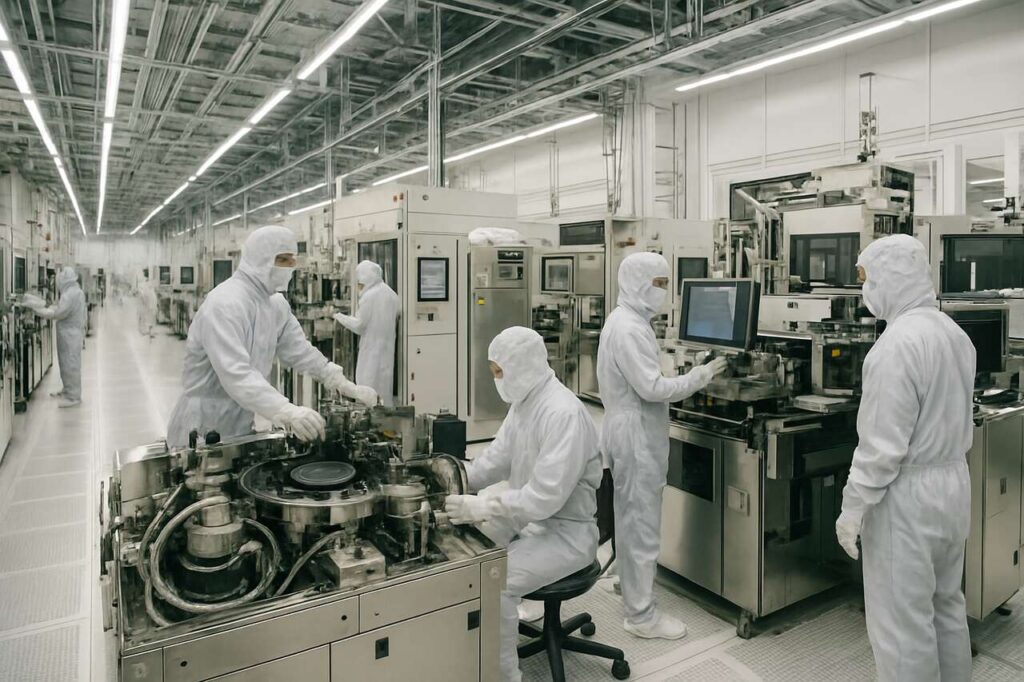
The semiconductor industry stands at a critical juncture as Taiwan Semiconductor Manufacturing Company initiates mass production of 2-nanometre chips, marking a pivotal moment in the global technology landscape. This achievement represents more than a technical milestone; it underscores Taiwan’s strategic importance in an increasingly interconnected yet geopolitically fragmented world. As nations grapple with supply chain vulnerabilities and technological sovereignty, the island’s role as the primary supplier of advanced semiconductors has transformed from an economic asset into a matter of international security. The commencement of this cutting-edge production comes at a time when demand for high-performance computing continues to surge, driven predominantly by artificial intelligence applications and next-generation technologies.
TSMC: strengthening Taiwan’s tech shield
The foundation of semiconductor dominance
Since its establishment in 1987, Taiwan Semiconductor Manufacturing Company has revolutionised the semiconductor industry through its pioneering foundry model. This innovative approach separated chip design from manufacturing, allowing countless technology companies to focus on innovation whilst outsourcing production to a specialist manufacturer. The company’s evolution from a nascent venture to the world’s most advanced chipmaker reflects decades of strategic investment, technological expertise, and unwavering commitment to pushing the boundaries of what is physically possible in semiconductor fabrication.
Strategic positioning in the global market
The company’s dominance extends far beyond mere market share. Its position as the sole manufacturer of the most advanced chips creates a unique situation where global technology giants depend entirely on Taiwanese production capacity. This concentration of capability has transformed the island into what analysts describe as a “silicon shield” – a strategic asset whose value provides a degree of protection through economic interdependence. The following factors contribute to this unassailable position:
- Unmatched technological expertise accumulated over decades
- Massive capital investments in research and development
- Sophisticated supply chain integration
- Highly skilled workforce specialising in advanced manufacturing
- Strong relationships with leading technology companies worldwide
Investment in cutting-edge capabilities
The journey towards 2-nanometre production required extraordinary financial commitment and technical innovation. The company has allocated billions towards developing fabrication facilities capable of producing chips at this scale, where individual transistors measure mere atoms across. This investment represents not merely an upgrade but a fundamental reimagining of manufacturing processes, requiring new materials, equipment, and methodologies. The scale of this undertaking demonstrates the company’s determination to maintain its technological lead despite intensifying competition from rivals across Asia and beyond.
This technological supremacy naturally raises questions about how these advances will reshape the broader technology landscape and what capabilities they unlock for future applications.
Implications of 2-nanometre chips for technology
Performance and efficiency gains
The transition to 2-nanometre process technology delivers substantial improvements across multiple dimensions. These chips offer enhanced performance whilst simultaneously reducing power consumption – a combination critical for everything from data centres to mobile devices. The following table illustrates the comparative advantages:
| Metric | Improvement over previous generation |
|---|---|
| Processing speed | 10-15% increase |
| Power efficiency | 25-30% reduction in consumption |
| Transistor density | Approximately double |
| Heat generation | 20% decrease |
Enabling next-generation applications
These technical specifications translate into tangible benefits for emerging technologies. Artificial intelligence systems require enormous computational resources, and the efficiency gains from 2-nanometre chips enable more sophisticated models to run on less power. Similarly, autonomous vehicles, advanced medical imaging, and quantum computing applications all benefit from the increased processing density these chips provide. The technology essentially removes previous bottlenecks that constrained innovation, opening new possibilities for applications previously considered impractical or impossible.
Economic ripple effects
Beyond technical specifications, the availability of 2-nanometre chips creates competitive advantages for companies with early access. Technology firms incorporating these components into their products gain measurable performance advantages over rivals, potentially shifting market dynamics across multiple sectors. This technological edge translates into commercial value, driving demand and justifying premium pricing for devices incorporating the latest silicon.
The remarkable capabilities of these chips have not emerged in isolation but rather in response to specific market pressures, particularly from the artificial intelligence sector.
Accelerated production to meet AI demand
The artificial intelligence computing challenge
Artificial intelligence applications present unique computational demands that strain existing hardware capabilities. Training large language models and neural networks requires processing vast datasets through billions of calculations, consuming enormous amounts of electricity and generating substantial heat. The 2-nanometre chips address these challenges directly, offering the processing density and efficiency necessary to make advanced AI systems economically viable. Without such advances, the current trajectory of AI development would face fundamental physical and economic constraints.
Scaling production capacity
Meeting surging demand requires more than technological capability; it demands manufacturing scale. The company has implemented aggressive production ramp-up schedules, expanding fabrication capacity across multiple facilities. This expansion involves:
- Construction of additional clean rooms for chip fabrication
- Installation of advanced lithography equipment
- Training thousands of specialised technicians
- Securing supply chains for exotic materials and chemicals
- Implementing quality control systems for nanoscale manufacturing
Customer commitments and partnerships
Major technology companies have secured production capacity through long-term agreements, essentially reserving manufacturing slots years in advance. These commitments provide the financial certainty necessary for the company to justify massive capital expenditures whilst giving customers assurance of supply. The strategic partnerships extend beyond simple supplier relationships, often involving collaborative development of custom chip designs optimised for specific applications, from smartphone processors to data centre accelerators.
Whilst production expands in Taiwan, geopolitical considerations have prompted parallel developments in other regions, particularly North America.
Relaxed tech restrictions: production in the United States
Strategic diversification initiatives
Recognition of concentration risk has driven efforts to establish advanced semiconductor manufacturing outside Taiwan. The United States government has provided substantial financial support, including a $6.6 billion direct investment announced in 2024, to encourage construction of fabrication facilities on American soil. These initiatives aim to create domestic production capacity for critical chips, reducing dependence on a single geographic location vulnerable to potential disruption.
Technical and logistical challenges
Replicating Taiwan’s semiconductor ecosystem elsewhere presents formidable obstacles. The island’s manufacturing prowess results from decades of accumulated expertise, supplier relationships, and workforce development that cannot be instantly transplanted. American facilities face challenges including:
- Higher construction and operational costs
- Limited availability of experienced semiconductor engineers
- Less developed local supply chains for specialised materials
- Longer timelines for facility certification and ramp-up
- Regulatory complexities in environmental and safety compliance
Balancing technology transfer and security
Establishing advanced production abroad requires transferring sensitive manufacturing knowledge whilst maintaining competitive advantages. The company must navigate complex decisions about which technologies to share and which to retain exclusively in Taiwan. These considerations intersect with national security concerns, as governments seek to ensure that critical capabilities remain protected whilst simultaneously desiring access to cutting-edge manufacturing on their territory.
These manufacturing decisions occur within a broader context where semiconductor production has transcended purely commercial considerations to become a matter of international security.
The silicon revolution: a global security issue
Geopolitical tensions and technological dependence
Taiwan’s semiconductor dominance creates a unique vulnerability for the global economy. The concentration of advanced chip production on an island subject to territorial claims by China presents a scenario where geopolitical conflict could instantly disrupt the technology supply chain underpinning modern civilisation. This reality has elevated semiconductor policy from a commercial matter to a central concern of foreign policy and defence planning for major powers.
Economic consequences of supply disruption
Analysts have modelled the potential impact of disruption to Taiwanese chip production, with scenarios suggesting catastrophic economic consequences. The following sectors would face immediate critical shortages:
- Consumer electronics manufacturing
- Automotive production
- Telecommunications infrastructure
- Medical equipment
- Defence systems
- Data centre operations
The ripple effects would extend far beyond technology sectors, as modern economies depend on semiconductors for virtually every aspect of commercial activity, from payment processing to logistics management.
International responses and strategic planning
Recognition of these vulnerabilities has prompted nations to develop semiconductor strategies aimed at reducing dependence and ensuring supply security. These initiatives include financial incentives for domestic production, research investments in alternative technologies, and diplomatic efforts to maintain stability in the Taiwan Strait. The semiconductor issue has become inseparable from broader questions of technological sovereignty and economic security in an increasingly multipolar world.
As these strategic considerations evolve, the semiconductor industry itself continues to advance, with new technologies and market dynamics emerging on the horizon.
Prospects and future scenarios for the semiconductor industry
Beyond 2-nanometre technology
The semiconductor industry shows no signs of reaching fundamental physical limits despite decades of predictions. Research continues into even smaller process nodes, with 1-nanometre and sub-nanometre technologies under development. These advances will require entirely new approaches to chip architecture, potentially incorporating quantum effects deliberately rather than treating them as obstacles to overcome. The transition may also involve new materials beyond traditional silicon, including carbon nanotubes and other exotic compounds.
Emerging competitors and market dynamics
Whilst Taiwan maintains its current lead, other nations are investing heavily in developing competitive capabilities. India has announced ambitions to achieve semiconductor self-sufficiency by 2029, whilst China continues substantial investments despite technology transfer restrictions. The following table summarises major national semiconductor initiatives:
| Country/Region | Investment commitment | Target timeline |
|---|---|---|
| United States | $52 billion | 2025-2030 |
| European Union | €43 billion | 2023-2030 |
| China | $150 billion+ | 2020-2030 |
| India | $10 billion | 2024-2029 |
Technological convergence and new applications
The semiconductor industry increasingly intersects with other emerging technologies, creating opportunities for transformative innovations. Quantum computing, neuromorphic processors, and photonic chips represent potential paradigm shifts that could reshape the competitive landscape. These technologies may favour different manufacturing approaches and geographical locations, potentially redistributing the strategic advantages currently concentrated in Taiwan.
The commencement of 2-nanometre chip production represents a watershed moment for both technology and geopolitics. Taiwan’s position as the indispensable supplier of advanced semiconductors provides economic benefits whilst simultaneously creating vulnerabilities that concern policymakers worldwide. The chips enable unprecedented computational capabilities, particularly for artificial intelligence applications driving the current technology revolution. Efforts to diversify production geographically face substantial challenges but continue to advance, driven by security considerations that transcend purely commercial logic. As the industry evolves towards even more advanced nodes and explores alternative technologies, the strategic importance of semiconductor manufacturing will likely intensify rather than diminish. The intersection of technological innovation, economic interdependence, and geopolitical tension ensures that developments in this sector will remain central to international affairs for the foreseeable future.