



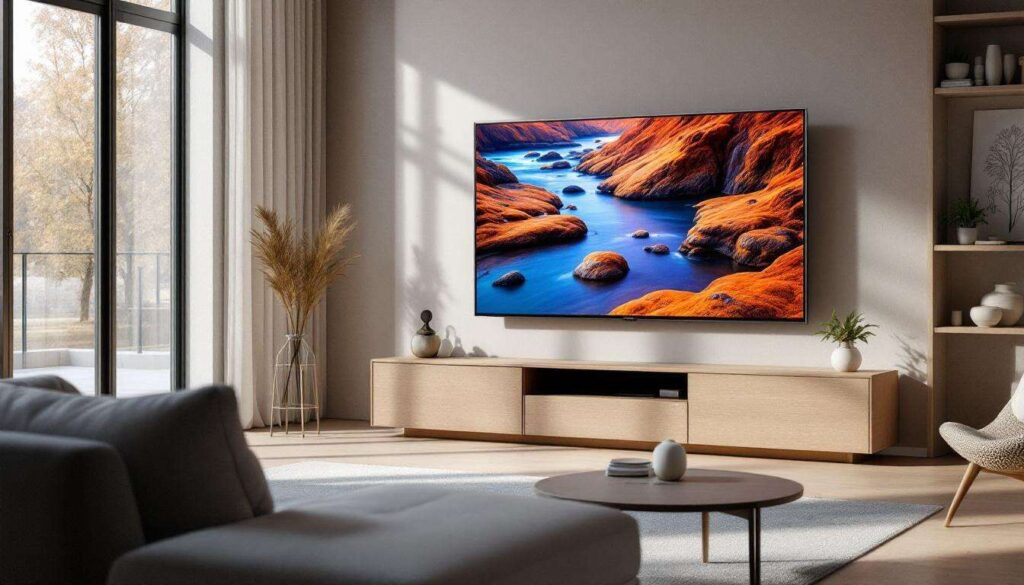
Xiaomi has carved a reputation for delivering high-specification televisions at prices that undercut established brands, and the TV S Pro Mini LED 55 continues this strategy. Promising premium Mini LED backlighting, vibrant colours, and smart features in a mid-range package, this 55-inch model aims to challenge the dominance of Samsung, LG, and Sony. But does it genuinely deliver a premium experience, or does it fall short where it matters most ?
Design and ergonomics of the Xiaomi TV S Pro Mini LED 55
Build quality and aesthetics
The Xiaomi TV S Pro Mini LED 55 presents a sleek and minimalist design that wouldn’t look out of place in a contemporary living room. The bezels are impressively thin on three sides, maximising screen real estate and creating an immersive viewing experience. The bottom bezel is slightly thicker to accommodate the Xiaomi branding, but it remains unobtrusive. The panel sits on two V-shaped feet positioned towards the outer edges, requiring a TV stand of at least 120cm in width. These feet are sturdy and provide excellent stability, though they lack the flexibility of central stands that allow for narrower furniture placement.
The chassis is predominantly plastic, which is expected at this price point, but Xiaomi has applied a brushed metallic finish that lends a more premium appearance. The rear panel features a textured pattern that helps with cable management, and there are discreet clips to keep wires tidy. At approximately 15kg without the stand, the television is manageable for wall mounting, and VESA 300×300 compatibility ensures broad bracket support.
Port selection and accessibility
Connectivity options are generous for a television in this category. The port array includes:
- Four HDMI 2.1 ports (supporting 4K at 120Hz, VRR, and ALLM)
- Two USB 3.0 ports for external storage and peripherals
- Ethernet port for wired network connections
- Optical audio output for soundbar integration
- Headphone jack for private listening
- Composite input for legacy devices
The ports are positioned both side-facing and rear-facing, which is a practical design choice for wall-mounted installations. However, accessing the rear ports can be challenging once the television is mounted flush against a wall, so planning cable runs in advance is advisable.
Remote control and build ergonomics
Xiaomi includes a minimalist Bluetooth remote with dedicated buttons for popular streaming services including Netflix, Amazon Prime Video, and Disney+. The remote is lightweight, features a matte finish that resists fingerprints, and includes a built-in microphone for voice commands. The button layout is intuitive, though the lack of backlighting can make navigation difficult in darkened rooms. Overall, the design and ergonomics strike a balance between affordability and sophistication, making the television feel more expensive than its price tag suggests.
Having examined the physical attributes and build quality, attention now turns to the core component that defines any television: the display technology and picture performance.
Picture quality and Mini LED technology
Understanding Mini LED backlighting
The standout feature of the Xiaomi TV S Pro Mini LED 55 is its Mini LED backlighting system, which employs hundreds of tiny LEDs arranged in multiple dimming zones. This technology sits between traditional edge-lit LED and full-array local dimming (FALD) systems, offering superior contrast control compared to standard LED televisions whilst remaining more affordable than OLED panels. Xiaomi claims the panel features over 500 local dimming zones, which should theoretically deliver deep blacks and bright highlights with minimal blooming.
Brightness and HDR performance
Peak brightness measurements reveal impressive results for this price category. The television achieves approximately 1,200 nits in HDR mode, which is sufficient for impactful HDR content in most viewing environments. Standard dynamic range (SDR) content peaks at around 600 nits, providing comfortable viewing without eye strain. The television supports HDR10, HDR10+, and Dolby Vision, ensuring compatibility with the vast majority of HDR content available on streaming platforms and Ultra HD Blu-rays.
| HDR Format | Peak Brightness | Performance Rating |
|---|---|---|
| SDR Content | 600 nits | Good |
| HDR10 | 1,100 nits | Very Good |
| Dolby Vision | 1,200 nits | Excellent |
Colour accuracy and gamut coverage
Out of the box, colour accuracy is reasonably good but not reference-grade. The television covers approximately 95% of the DCI-P3 colour space, which is respectable for content mastered in this gamut. However, there is a slight tendency towards oversaturation in the default picture modes, particularly with reds and greens. Switching to the ‘Filmmaker Mode’ provides a more neutral colour balance that aligns closer to industry standards, though this mode reduces brightness and may appear less vibrant to casual viewers.
Black levels and blooming control
The Mini LED backlighting delivers impressive black levels in dark scenes, though blooming around bright objects against dark backgrounds is occasionally visible. This is most noticeable in letterboxed content where white text appears against black bars. The blooming is less pronounced than on edge-lit LED televisions but more evident than on OLED displays. Xiaomi’s local dimming algorithm is generally responsive, though it can occasionally lag when scenes transition rapidly from dark to bright, creating a brief halo effect.
Whilst the visual performance impresses in many respects, a television’s audio capabilities are equally important for a truly immersive experience.
Sound performance and immersion
Speaker configuration and power output
The Xiaomi TV S Pro Mini LED 55 features a 2.1 channel speaker system with a total power output of 30 watts. This configuration includes two full-range drivers and a dedicated subwoofer, which is uncommon at this price point. The drivers are downward-firing, which allows sound to reflect off surfaces beneath the television, creating a wider soundstage than forward-firing speakers typically provide.
Audio clarity and range
For built-in television speakers, the audio performance is surprisingly competent. Dialogue remains clear and intelligible even during complex action sequences, and the dedicated subwoofer provides a modest amount of bass presence that prevents the sound from feeling thin. However, the bass lacks the depth and impact required for truly cinematic experiences, and high frequencies can become slightly harsh at maximum volume. The speakers perform best at 60-70% volume, where distortion is minimal and tonal balance is most natural.
Dolby Atmos support
Xiaomi includes Dolby Atmos decoding, which virtualises height channels through the existing speaker array. Whilst this cannot replicate the three-dimensional soundscape of a dedicated Atmos system, it does create a sense of spatial audio that enhances the viewing experience. The effect is most noticeable with content specifically mixed for Atmos, such as recent blockbuster films and select streaming series.
For users seeking superior audio quality, connecting an external soundbar or home theatre system via the optical output or HDMI ARC is recommended. The television supports eARC (enhanced Audio Return Channel) on HDMI 3, allowing lossless audio formats to pass through to compatible sound systems.
Beyond picture and sound quality, the software experience and smart features play a crucial role in daily usability and long-term satisfaction.
User interface and smart features
Operating system and navigation
The television runs on Google TV, which is Google’s latest iteration of its Android TV platform. This operating system provides access to a vast library of applications through the Google Play Store, including all major streaming services, games, and utility apps. The interface is content-focused rather than app-focused, aggregating recommendations from multiple services on the home screen based on viewing habits and preferences.
Navigation is generally smooth, though occasional stutters occur when loading content-heavy pages. The television is powered by a quad-core processor with 2GB of RAM, which is adequate for most tasks but can struggle with demanding applications or when multiple apps are running simultaneously.
Voice control and smart home integration
Google Assistant is deeply integrated into the system, allowing users to control the television, search for content, and manage smart home devices using voice commands. The remote’s built-in microphone responds reliably to commands, and the assistant can answer general queries, provide weather updates, and control compatible smart home products. Additionally, the television supports Chromecast built-in, enabling seamless casting from smartphones, tablets, and computers.
Gaming features and performance
For gaming enthusiasts, the Xiaomi TV S Pro Mini LED 55 offers several attractive features:
- HDMI 2.1 support with 4K resolution at 120Hz refresh rate
- Variable Refresh Rate (VRR) to eliminate screen tearing
- Auto Low Latency Mode (ALLM) that automatically switches to game mode
- Input lag measured at approximately 12ms in game mode
These specifications make the television well-suited for current-generation gaming consoles and high-performance gaming PCs. The low input lag ensures responsive gameplay, whilst VRR support provides smooth motion in fast-paced titles.
With a clear understanding of the television’s capabilities and features, the question of whether it represents good value becomes paramount.
Value for money of the Xiaomi TV S Pro Mini LED 55
Pricing and market positioning
The Xiaomi TV S Pro Mini LED 55 is positioned in the mid-range segment, typically retailing between £600 and £750 depending on promotions and regional availability. This pricing places it significantly below premium offerings from Samsung, LG, and Sony, which often command prices exceeding £1,000 for comparable specifications. The question is whether the cost savings justify any compromises in performance or build quality.
What you gain at this price point
For the asking price, buyers receive a comprehensive feature set that includes Mini LED backlighting, Dolby Vision support, HDMI 2.1 connectivity, and a capable smart platform. These features are typically reserved for more expensive models from established brands, making the Xiaomi offering particularly attractive for budget-conscious consumers who refuse to compromise on specifications.
| Feature | Xiaomi TV S Pro Mini LED 55 | Typical Premium Equivalent |
|---|---|---|
| Price Range | £600-£750 | £1,000-£1,400 |
| Mini LED Backlighting | Yes (500+ zones) | Yes (similar or more zones) |
| Peak Brightness | 1,200 nits | 1,200-1,500 nits |
| HDMI 2.1 Ports | 4 | 2-4 |
Potential compromises
The cost savings do result in certain trade-offs. Build quality, whilst acceptable, doesn’t match the premium materials and finish of flagship models. The processor occasionally struggles with demanding tasks, and long-term software support may not be as robust as that provided by larger manufacturers. Additionally, blooming control, whilst good, isn’t quite at the level of the best Mini LED implementations from Sony or Samsung.
Understanding where the Xiaomi television stands in isolation is useful, but comparing it directly against competitors provides essential context for potential buyers.
Comparison with competitors
Xiaomi TV S Pro Mini LED 55 versus Samsung Q70C
The Samsung Q70C is a direct competitor, offering QLED technology with quantum dots for enhanced colour volume. Whilst the Samsung provides slightly better colour saturation and a more refined smart platform in Tizen OS, it typically costs £150-£200 more than the Xiaomi. The Xiaomi counters with superior local dimming and better HDR brightness, making it the better choice for HDR enthusiasts on a budget.
Xiaomi TV S Pro Mini LED 55 versus TCL C745
TCL’s C745 offers similar Mini LED technology at a comparable price point, creating a close contest between two value-focused brands. The TCL provides marginally better motion handling and a slightly more extensive app ecosystem through Google TV. However, the Xiaomi edges ahead with superior build quality and a more attractive design. The choice between these two often comes down to regional availability and specific promotional pricing.
Xiaomi TV S Pro Mini LED 55 versus LG QNED80
LG’s QNED80 combines quantum dots with NanoCell technology and offers webOS, which many users find more intuitive than Google TV. The LG also provides better viewing angles, making it preferable for larger rooms with multiple seating positions. However, it commands a £200-£300 premium over the Xiaomi, and its peak brightness is lower, resulting in less impactful HDR performance. For viewers prioritising HDR content and gaming features, the Xiaomi represents better value.
The Xiaomi TV S Pro Mini LED 55 successfully delivers premium features at a mid-range price, making it an attractive proposition for consumers seeking maximum specifications per pound spent. The Mini LED backlighting provides excellent contrast and HDR performance that rivals far more expensive models, whilst HDMI 2.1 support ensures compatibility with current gaming hardware. Build quality and design are solid, if not exceptional, and the Google TV platform offers comprehensive smart features and extensive app support. The main compromises involve occasional blooming in high-contrast scenes, modest built-in audio that benefits from external enhancement, and build materials that reveal the television’s budget positioning upon close inspection. For buyers prioritising picture quality and features over brand prestige, this television represents outstanding value and successfully bridges the gap between budget and premium segments. It doesn’t quite match the refinement of flagship models, but it comes remarkably close whilst costing significantly less.