



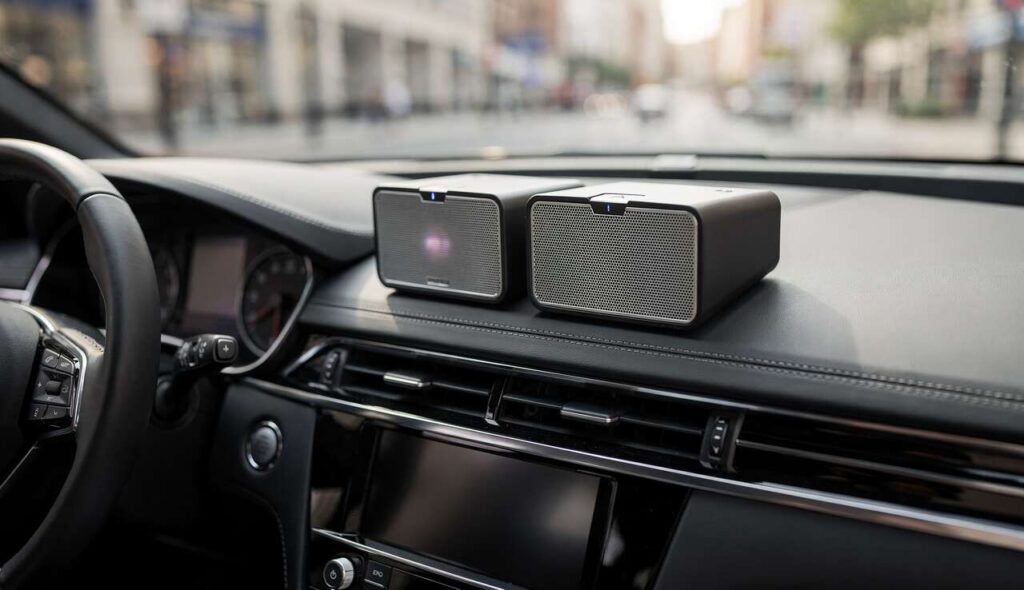
Car theft has entered a new era of sophistication, with criminals exploiting technology that was designed to make our lives easier. Security researchers have demonstrated that inexpensive Bluetooth speakers, available for as little as £30, can be modified to intercept wireless signals and unlock vehicles in under two minutes. This alarming development reveals critical vulnerabilities in the keyless entry systems that millions of motorists rely on daily. The technique, known as a relay attack, exploits the constant communication between a car and its key fob, turning affordable consumer electronics into powerful hacking tools. As vehicle manufacturers race to implement convenience features, they have inadvertently created security gaps that tech-savvy thieves are quick to exploit.
Understanding the role of Bluetooth speakers in car hacking
The modification process of consumer electronics
Bluetooth speakers serve as the foundation for these hacking devices due to their readily available wireless transmission capabilities and low cost. Criminals purchase basic models and reprogram their firmware to intercept and relay radio frequency signals rather than audio data. The modification requires minimal technical expertise, with detailed instructions circulating on underground forums and dark web marketplaces. These altered devices maintain their innocuous appearance, allowing thieves to operate without drawing attention from passersby or security personnel.
The transformation involves installing custom software that enables the speaker to function as a signal amplifier and relay station. Key components include:
- Modified Bluetooth chips capable of extended range transmission
- Custom firmware that intercepts key fob signals
- Battery packs providing sufficient power for sustained operation
- Compact antennas hidden within the speaker casing
Why these devices are particularly effective
The effectiveness of modified Bluetooth speakers stems from their ability to extend the range of key fob signals beyond their intended operational distance. Modern keyless entry systems constantly emit low-power radio signals to detect when the authorised key is nearby. The hacked speakers capture these signals and retransmit them over distances of up to 100 metres, fooling the vehicle into believing the legitimate key is present. This method bypasses traditional security measures because the car receives genuine authentication codes from the actual key fob, making detection nearly impossible for standard security systems.
These attacks exploit the fundamental design of convenience-focused automotive technology, raising questions about the balance between user experience and security protocols. Understanding these vulnerabilities provides essential context for examining the underlying technological weaknesses in modern vehicles.
Underlying technology and vulnerabilities of modern cars
How keyless entry systems function
Keyless entry systems operate through radio frequency identification technology that establishes communication between a vehicle and its paired key fob. When a driver approaches their car, the vehicle continuously broadcasts a low-frequency signal searching for its matching key. Upon detecting the correct response from the key fob, the car unlocks its doors and enables the ignition system. This seamless interaction occurs within milliseconds, providing the convenience that modern motorists expect. However, the system assumes that signal proximity equates to physical proximity, an assumption that relay attacks systematically exploit.
Specific weaknesses in wireless communication protocols
The primary vulnerability lies in the absence of distance verification mechanisms within most keyless entry systems. Manufacturers prioritised convenience and cost-effectiveness over comprehensive security measures, resulting in systems that authenticate signals without confirming the physical location of the key fob. Additional weaknesses include:
- Unencrypted or weakly encrypted signal transmission between key and vehicle
- Continuous broadcasting that allows interception opportunities
- Lack of time-based authentication that could detect relay delays
- Insufficient signal strength verification protocols
- Absence of motion sensors in key fobs that could detect suspicious activity
| Vehicle Brand | Vulnerability Level | Average Unlock Time |
|---|---|---|
| Premium German Manufacturers | High | 90 seconds |
| Japanese Brands | Medium-High | 105 seconds |
| American Manufacturers | Medium | 120 seconds |
| Budget Brands | Very High | 75 seconds |
These technological shortcomings create opportunities for criminals who understand the mechanics of wireless authentication, demonstrating how security often lags behind innovation in the automotive sector. The methods employed by these criminals reveal a sophisticated understanding of both technology and human behaviour.
Hackers’ tactics: how cars are unlocked
The relay attack methodology explained
Relay attacks require two modified devices working in coordination, typically operated by a pair of criminals. The first individual positions themselves near the target vehicle with a device that captures the car’s searching signal. The second person stands close to the building where the key fob is located, often near a front door or window. Their device picks up the key fob’s response and relays it back to the accomplice at the vehicle. This creates an unbroken chain of communication that convinces the car its authorised key is present, triggering the unlocking mechanism and allowing the thieves to enter and start the vehicle.
Real-world execution and timing
The entire process unfolds with alarming speed and efficiency. Criminals typically operate during evening hours when residents are home but keys are left near entry points. The attack sequence follows this pattern:
- Surveillance phase to identify target vehicles and key locations (5-10 minutes)
- Device positioning and signal testing (30-45 seconds)
- Signal relay and vehicle unlocking (10-15 seconds)
- Vehicle entry and ignition activation (20-30 seconds)
- Departure from the scene (under 60 seconds total from unlock to driving away)
Why traditional security measures fail
Conventional anti-theft systems prove ineffective against relay attacks because no forced entry occurs. Alarms remain silent as the vehicle receives legitimate authentication signals. Steering locks and immobilisers disengage normally because the car’s computer systems detect no anomalies. Even CCTV footage often shows what appears to be a normal unlocking sequence, making prosecution difficult. The sophistication of these attacks represents a significant escalation in automotive crime, with implications extending beyond individual vehicle owners.
Consequences for vehicle owners and public safety
Financial impact on victims
Vehicle owners face substantial financial losses when their cars are stolen through relay attacks. Insurance premiums increase significantly following theft claims, with some insurers refusing to cover keyless vehicles or imposing prohibitive excess charges. Many victims discover that their comprehensive policies contain clauses limiting coverage for keyless theft, particularly if keys were not stored securely. The average financial impact includes:
| Cost Category | Average Amount |
|---|---|
| Vehicle replacement excess | £500-£1,500 |
| Increased annual premium | £300-£800 |
| Personal items stolen from vehicle | £200-£600 |
| Replacement keys and reprogramming | £300-£500 |
Broader implications for public safety
Beyond individual losses, relay attacks contribute to wider criminal activities. Stolen vehicles frequently facilitate other crimes, including burglaries, drug trafficking, and violent offences. Police resources become stretched investigating these thefts, diverting attention from other public safety priorities. The ease of execution has led to organised crime groups specifically targeting areas with high concentrations of keyless vehicles, creating hotspots of criminal activity that affect entire communities.
Psychological effects on motorists
The violation of having a vehicle stolen from one’s driveway creates lasting anxiety and erodes the sense of security that homeowners should feel. Many victims report difficulty sleeping, constant checking of vehicles, and reluctance to purchase replacement cars with similar technology. This psychological toll extends beyond the immediate financial consequences, affecting quality of life and trust in automotive technology. Addressing these multifaceted consequences requires practical defensive strategies that motorists can implement immediately.
Recommended protective measures for motorists
Physical security enhancements
Implementing layered physical security provides the most effective defence against relay attacks. Faraday pouches or boxes block radio frequency signals when storing key fobs, preventing criminals from detecting or amplifying their transmissions. These shielded containers cost between £10 and £40, representing minimal investment for substantial protection. Additional physical measures include:
- Steering wheel locks that provide visible deterrence and mechanical barriers
- Driveway bollards or posts that prevent vehicle removal
- Wheel clamps for overnight security
- GPS tracking devices hidden within vehicles for recovery assistance
- Security lighting with motion sensors covering parking areas
Behavioural changes and best practices
Modifying daily habits significantly reduces vulnerability to relay attacks. Never leave key fobs near doors, windows, or exterior walls where signals can be intercepted. Store keys in central locations, preferably in metal containers or dedicated signal-blocking storage. When parking in public spaces, use additional mechanical locks and park in well-lit, monitored areas. Disable keyless entry systems when not needed, though this requires consulting vehicle manuals as the process varies by manufacturer.
Technological solutions and upgrades
Several aftermarket products offer enhanced protection against relay attacks. Motion-sensor key fobs that enter sleep mode when stationary prevent signal interception. Automotive security systems with encrypted rolling codes and distance verification provide superior protection compared to factory-installed systems. Some manufacturers now offer software updates that implement additional security layers, though uptake remains inconsistent across the industry. These individual protective measures operate within a broader regulatory framework that continues to evolve.
The evolution of legislation in response to these technological threats
Current regulatory landscape
Legislative responses to relay attacks have proven frustratingly slow and fragmented. Existing laws address vehicle theft but fail to specifically criminalise the possession or modification of signal relay devices. This legal ambiguity complicates prosecution efforts, as criminals can claim legitimate purposes for modified electronics. Some jurisdictions have introduced regulations requiring manufacturers to implement minimum security standards, though enforcement mechanisms remain weak and penalties insufficient to drive meaningful change.
Proposed reforms and industry standards
Regulatory bodies are developing comprehensive frameworks to address automotive cybersecurity threats. Proposed measures include:
- Mandatory distance-bounding protocols in all new keyless systems
- Regular security audits and penetration testing requirements
- Standardised vulnerability disclosure procedures
- Criminal penalties for possession of signal relay devices without legitimate purpose
- Mandatory security updates for vehicles throughout their operational lifespan
International cooperation and future outlook
Cross-border collaboration has intensified as organised crime groups operate internationally. Law enforcement agencies share intelligence on relay attack methodologies and equipment suppliers. Industry working groups bring together manufacturers, security researchers, and regulators to develop robust standards. However, implementation timelines extend years into the future, leaving current vehicle owners vulnerable. The pace of regulatory development must accelerate to match the rapidly evolving threat landscape, though political will and industry resistance continue to impede progress.
The vulnerability of modern vehicles to relay attacks using modified Bluetooth speakers represents a critical intersection of convenience and security. Motorists must recognise that technological advancement does not automatically equate to enhanced protection. Implementing physical security measures, modifying storage habits for key fobs, and remaining vigilant about parking locations provide immediate defensive options. Simultaneously, pressure must continue on manufacturers and legislators to prioritise security alongside convenience features. The automotive industry’s response to these threats will determine whether keyless technology remains viable or becomes an unsustainable liability. Individual action combined with systemic reform offers the most promising path towards securing vehicles against this evolving criminal methodology.