



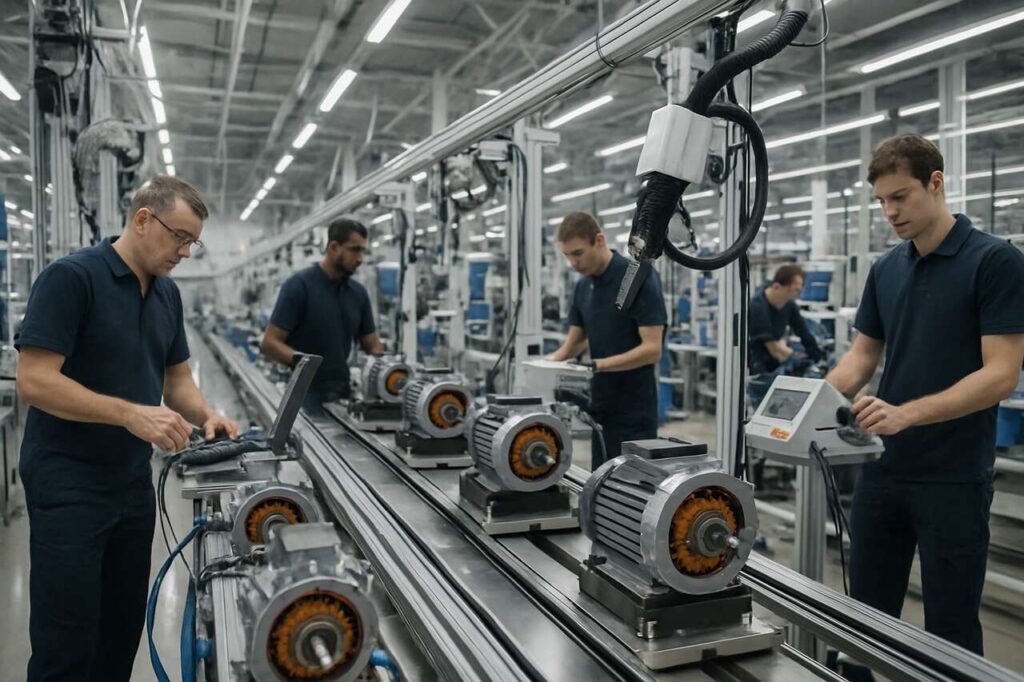
Electric motors have long been hailed as marvels of engineering efficiency, with traction motors in electric vehicles routinely achieving performance levels above 95%. Yet despite these impressive figures, the industry faces a paradox: investing millions in marginal efficiency gains whilst simultaneously overlooking significant energy losses elsewhere in the system. The real bottleneck limiting electric vehicle performance lies not in the motors themselves, but in the auxiliary systems that support them.
The True Efficiency of Electric Motors: beyond Appearances
Understanding motor efficiency metrics
Electric vehicle traction motors demonstrate remarkable efficiency levels, typically operating between 80% and 95% under normal driving conditions. This performance stands in stark contrast to traditional internal combustion engines, which struggle to exceed 40% efficiency. Engineers have devoted considerable resources to pushing these boundaries even further, with some manufacturers investing heavily to achieve improvements as small as 0.1% in efficiency gains.
However, these figures tell only part of the story. The efficiency ratings commonly cited refer exclusively to the primary traction motor and inverter assembly, excluding the broader ecosystem of components that contribute to overall vehicle performance. This narrow focus creates a misleading picture of true system efficiency.
The cost of marginal improvements
The pursuit of incremental efficiency gains in already highly optimised systems presents several challenges:
- Development costs escalate exponentially as efficiency approaches theoretical limits
- Manufacturing complexity increases with each fractional improvement
- Material costs rise as exotic alloys and advanced manufacturing techniques become necessary
- Testing and validation requirements multiply to verify marginal gains
These investments, whilst technically impressive, may not deliver proportionate benefits when viewed from a whole-system perspective. The question becomes whether resources might be better allocated to addressing less efficient components elsewhere in the vehicle.
Understanding where efficiency truly matters requires examining the complete energy flow throughout an electric vehicle, not merely the headline figures from primary drivetrain components.
The Overlooked Role of Auxiliary Systems in Electric Vehicles
Defining auxiliary systems
Auxiliary systems encompass all secondary motors and electrical components that support vehicle operation beyond the primary traction motor. These include:
- Cooling system pumps and fans
- Heating, ventilation and air conditioning (HVAC) units
- Power steering motors
- Brake vacuum pumps
- Battery thermal management systems
Whilst individually small, these systems collectively consume significant energy during vehicle operation. Their continuous or frequent operation means that even modest inefficiencies accumulate into substantial energy losses over time.
The efficiency gap in support systems
The stark reality confronting the industry is that many auxiliary motors operate at approximately 50% efficiency. This represents a dramatic contrast to the 95% efficiency achieved by traction motors. Consider the implications:
| Component | Typical Efficiency | Energy Loss |
|---|---|---|
| Traction motor | 95% | 5% |
| Standard auxiliary motor | 50% | 50% |
| High-efficiency auxiliary motor | 85% | 15% |
When a vehicle with a highly efficient traction motor relies on inefficient auxiliary systems, the overall system efficiency suffers dramatically. The energy wasted through auxiliary systems can completely negate the painstaking improvements made to primary drivetrain components.
Addressing these disparities requires a fundamental shift in how manufacturers approach vehicle efficiency optimisation, moving beyond component-level improvements towards integrated system design.
The Quest for Autonomy Without Altering the Battery
Range anxiety and practical solutions
Extending electric vehicle range has traditionally focused on two approaches: increasing battery capacity or reducing vehicle weight. Both strategies present significant challenges. Larger batteries add weight, cost and complexity, whilst weight reduction efforts eventually encounter practical and safety limitations.
Improving auxiliary system efficiency offers a third pathway that requires neither heavier batteries nor compromised vehicle structure. By recapturing energy currently lost through inefficient auxiliary motors, manufacturers can extend range without the drawbacks associated with battery enlargement.
Quantifying the range impact
The energy consumed by auxiliary systems varies considerably depending on driving conditions and climate requirements. In extreme weather conditions, HVAC systems alone can reduce range by 20-30%. Even under moderate conditions, auxiliary systems account for a measurable portion of total energy consumption.
Upgrading auxiliary motors from 50% to 85% efficiency could yield substantial benefits:
- Reduced heat generation requiring less cooling capacity
- Lower overall energy consumption extending available range
- Decreased thermal stress on battery systems improving longevity
- Enhanced performance consistency across varying ambient conditions
These improvements translate directly into increased practical range without requiring any changes to battery technology or capacity, offering a cost-effective pathway to enhanced vehicle performance.
Beyond passenger vehicles, similar principles apply across industrial applications where motor efficiency directly impacts operational costs and energy consumption.
Hidden Efficiency Gains in Steel Manufacturing
Industrial motor applications
The steel manufacturing industry relies heavily on electric motors for numerous processes, from rolling mills to conveyor systems. These facilities operate motors continuously, making efficiency improvements particularly valuable. Even small percentage gains in motor efficiency translate into substantial energy savings when multiplied across thousands of operating hours annually.
Cumulative energy impact
Industrial settings magnify the importance of motor efficiency through sheer scale of operation. A manufacturing facility might employ hundreds of motors ranging from small auxiliary units to massive primary drive systems. The energy consumption profile reveals significant opportunities:
| Motor Type | Quantity per Facility | Annual Operating Hours | Efficiency Impact |
|---|---|---|---|
| Large process motors | 10-20 | 8,000 | High visibility, already optimised |
| Medium auxiliary motors | 50-100 | 6,000 | Moderate attention, improvement potential |
| Small support motors | 200-500 | 4,000 | Often overlooked, significant collective impact |
Whilst major process motors receive regular attention and optimisation, the numerous smaller motors supporting ancillary functions often operate with outdated, inefficient designs. Collectively, these overlooked components can account for substantial energy waste that rivals or exceeds the consumption of primary systems.
The pattern observed in industrial settings mirrors the challenges found in smaller motor applications across diverse sectors.
Small Motors, large Losses
The proliferation of small motors
Modern applications increasingly rely on numerous small electric motors rather than fewer large ones. This trend towards distributed motor systems offers advantages in flexibility and control but introduces efficiency challenges. Small motors often receive less engineering attention than their larger counterparts, despite their collective significance.
Efficiency challenges at reduced scales
Several factors contribute to lower efficiency in small motors:
- Higher surface-area-to-volume ratios increase relative heat losses
- Manufacturing tolerances become proportionally more significant
- Cost pressures discourage use of premium materials and designs
- Limited space constraints optimal winding and magnetic circuit design
These technical challenges combine with economic realities. Manufacturers often prioritise initial cost over operational efficiency for small motors, assuming their individual energy consumption remains negligible. This assumption fails when considering the aggregate impact of hundreds or thousands of such motors operating simultaneously.
Recognising these patterns has prompted renewed attention to efficiency improvements across all motor sizes, particularly in industrial contexts where operational costs directly impact competitiveness.
Industrial Motors: an Energy-Saving Opportunity
Integrated efficiency approaches
Addressing motor efficiency bottlenecks requires moving beyond component-level optimisation towards integrated system design. This holistic approach considers the interaction between motors, control systems, and operational requirements. Engineers must evaluate total energy flow rather than focusing exclusively on individual component specifications.
Innovative solutions emerging in the market demonstrate the potential of this approach. High-efficiency auxiliary motors designed specifically to replace standard units offer significant improvements without requiring system redesign. These components achieve efficiency levels approaching those of primary traction motors whilst maintaining compatibility with existing installations.
Implementation strategies
Organisations seeking to capture efficiency gains from improved motor systems should consider:
- Conducting comprehensive energy audits identifying all motor applications and their operational profiles
- Prioritising replacements based on operating hours and current efficiency levels
- Evaluating total cost of ownership rather than initial purchase price alone
- Implementing monitoring systems to verify actual efficiency improvements
- Training maintenance personnel on proper installation and operation of high-efficiency motors
The business case for upgrading auxiliary and small motors strengthens as energy costs rise and environmental regulations tighten. Facilities that address these overlooked efficiency opportunities gain competitive advantages through reduced operating costs whilst contributing to broader sustainability objectives.
The path forward requires industry-wide recognition that true efficiency optimisation extends beyond headline specifications for primary components. By addressing auxiliary systems, small motors, and support equipment with the same rigour applied to main drive systems, manufacturers and operators can unlock substantial performance improvements that have remained hidden in plain sight.
The efficiency bottleneck in electric motors has never been about the motors themselves. Traction motors already achieve remarkable performance levels that approach theoretical limits. The real challenge lies in the auxiliary systems, small motors, and support equipment that collectively consume significant energy whilst operating at fraction of optimal efficiency. Addressing these overlooked components offers immediate opportunities for range extension in electric vehicles and substantial energy savings in industrial applications. Rather than investing millions in marginal improvements to already efficient systems, the industry must redirect attention towards the 50% efficient auxiliary motors that undermine overall performance. This shift in perspective, from component optimisation to integrated system efficiency, represents the most practical pathway to meaningful gains in both electric vehicle autonomy and industrial energy consumption.